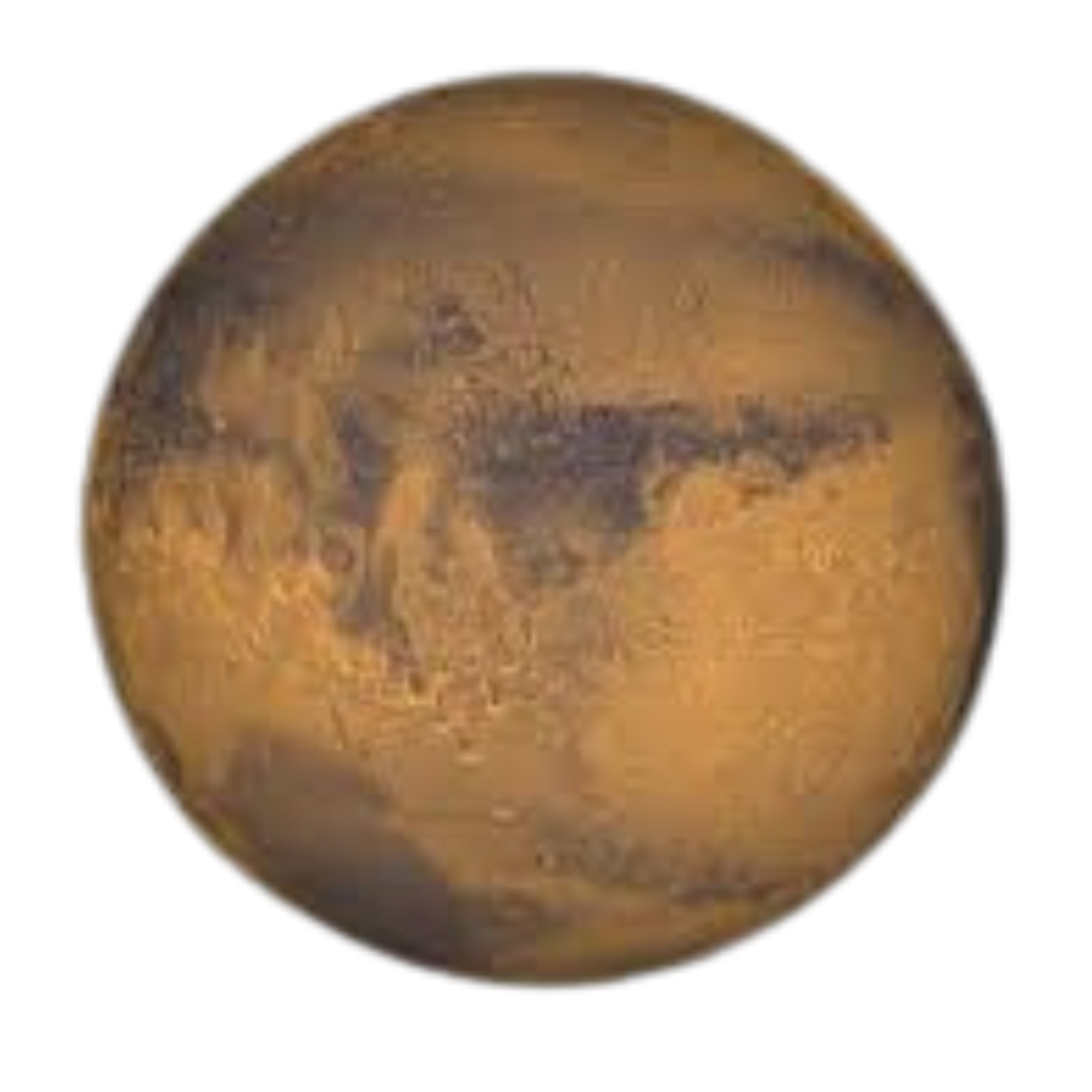
MARS
a dusty, cold, desert world
with a very thin atmosphere
Formation
Mars is the fourth planet from the Sun in our solar system. Scientists believe that all of the planets were created just over 4.5 billion years ago. The solar system began as a large cloud of gas, dust, and ice, which collapsed into a spinning disc. The Sun was formed at its centre and particles began sticking together along rings in the disc – leading to the formation of the planets.
Orbit and rotation
A year on Mars – the time it takes for the planet to orbit the Sun – is nearly twice as long as a year on . However, the planets rotate at a similar frequency: a day on Mars (known as a sol) lasts about 24 hours and 40 minutes in Earth time.
Mars is tilted by about 25 degrees, which means that the red planet has four seasons, too – each twice as long as Earth's!
Surface
Mars is known as the "red planet" due to its reddish hue caused by oxidized iron (or rust) on the planet's surface.
The tallest mountain in the entire solar system, Olympus Mons, is on Mars. This extinct volcano is nearly 22 km tall – roughly two and a half times the height of Mount Everest.
Valles Marineris is a massive canyon system that stretches over 3,000 km across Mars's surface – about the distance between Montreal and Calgary! Plunging about 8 km deep, and often referred to as "the Grand Canyon of Mars," Valles Marineris makes the red planet home to the largest known canyon in the solar system.
A rich past
Since liquid water cannot currently exist on the surface due to Mars's low atmospheric pressure, traces of ancient riverbeds and lakes imply that a vast quantity of liquid water may once have existed in the presence of a denser atmosphere.
Mars also used to have a global magnetic field, but scientists believe the planet lost it about 4 billion years ago. Some evidence suggests that ancient Mars may have been similar to Earth, and may have harboured the right conditions for life.
The exploration of Mars
Many missions have been sent to explore Mars, but only 50% have been successful due to the significant challenges caused by the Martian atmosphere. Landing safely on Mars requires a creative combination of heat-shielding, rocket-powered descent, and .
NASA's Viking 1 and Viking 2 spacecraft were the first to successfully land and explore the surface of Mars in 1975. These spacecraft were designed to search for signs of life on Mars.
One of the greatest successes in planetary exploration was the Opportunity rover, which landed on Mars in 2004. It had a planned mission lifetime of only 90 days but ended up exploring the Martian surface for over 14 years. The rover travelled a record-breaking 45 km of the Martian surface and helped scientists better understand Mars's geology and climate. Opportunity's twin, the Spirit rover, also collected data for over 20 times longer than its planned mission.
NASA's Crover, which is currently exploring Mars, has travelled over 20 km on the red planet's surface. Curiosity analyzes Martian soil with , led by Dr. Ralf Gellert (University of Guelph). To date, APXS has sent over 1500 scientific results back to Earth!
The Canadian Space Agency (CSA) also funds Canadian scientists who are participating in other international Mars missions:
- Dr. Livio Tornabene (Western University) and Dr. Ed Cloutis (University of Winnipeg) are involved in the European
Space Agency's ExoMars Trace Gas Orbiter, a satellite designed to study Martian atmosphere. The satellite also
carries a Canadian-built communication antenna subsystem.
- Dr. Catherine Johnson and Anna Mittelholz from the University of British Columbia are part of NASA's InSight
mission, which takes a closer look at the structure and composition of Mars's inner layers.
- Dr. Chris Herd from the University of Alberta is a participating scientist on the Mars 2020 mission, which includes
a rover designed to collect and store samples for possible return to Earth.
The future of Mars exploration will not only involve robots, but humans as well. With increased crew autonomy, the long-duration missions needed to reach the red planet will soon become reality.

Infographic comparing Planet Mars with Planet Earth. (Credit: CSA)