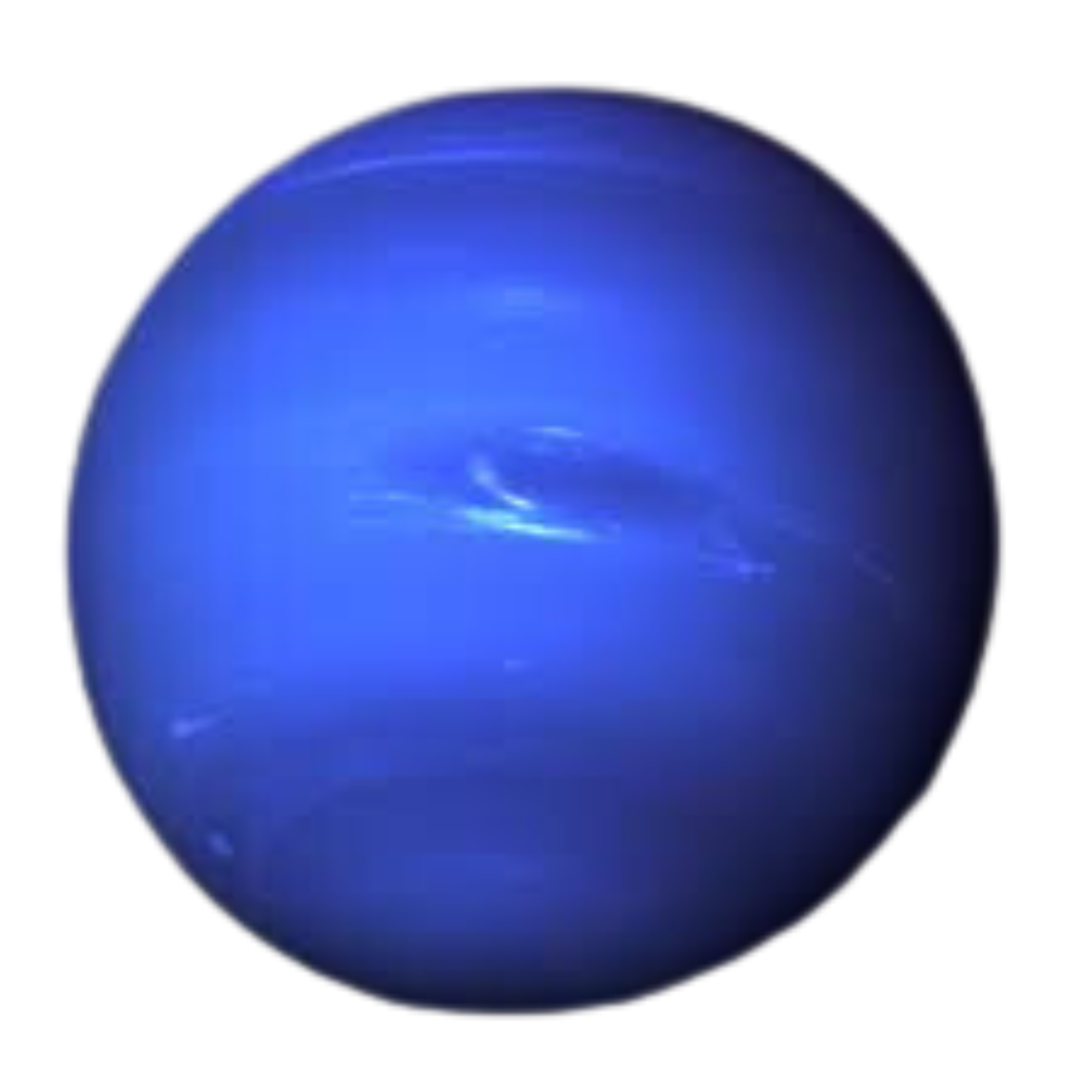
NEPTUNE
dark, cold, and very windy
one of the farthest planets
Formation
The eighth planet from the Sun, Neptune is considered an ice giant because it is largely made up of water, ammonia, and methane in solid form. As our solar system took shape about 4.5 billion years ago, Neptune was likely formed in a massive, ancient cloud of gas, dust, and ice which collapsed into a spinning disc with our Sun at its centre. Scientists believe the differences between ice giants and gas giants (like and ) are due to their slightly different formation histories.
Orbit and Rotation
Based on measurements taken by the Voyager 2 probe, different parts of Neptune may rotate at different speeds since the planet is not a solid body. Neptune's equator seems to rotate once every 18 hours while its polar regions spin once every 12 hours. This difference in rotational speed between the different regions is the largest of any planet and causes the strongest winds in the solar system, as fast as 2100 km/h!
Neptune takes 165 years to complete one full orbit around the Sun.
After about 75 years of being a planet, Pluto was reclassified as a by the International Astronomical Union in 2006. Neptune therefore regained its status as the outermost planet in the solar system.
Atmosphere and Surface
Like the other giant planets in our solar system, Neptune does not have a solid surface. Scientists believe that the interior of the planet is made up of a solid rocky core covered by a hot and dense liquid layer of water and ammonia. The atmosphere surrounding the interior of the planet is made up of mostly hydrogen and helium.
Neptune's blue colour is caused by the methane found in its atmosphere, which absorbs red light. Scientists are unsure why and Neptune are different shades of blue despite their very similar atmospheres. Like that of , Neptune's atmosphere contains many storm systems including the Great Dark Spot, which is about as wide as Earth.
The exploration of Neptune
Launched in 1977 to explore the outer solar system, NASA's Voyager 2 was the only spacecraft to fly by Neptune. It observed Neptune from a distance of about 4400 km in 1989 after having studied Uranus. The probe gathered information on Neptune's magnetic field, atmosphere, and several of the planet's moons. Voyager 2 also discovered Neptune's Great Dark Spot.

This infographic features an image of Neptune along with a series of facts that highlight
some of the differences between Neptune and Earth. (Credit: CSA)