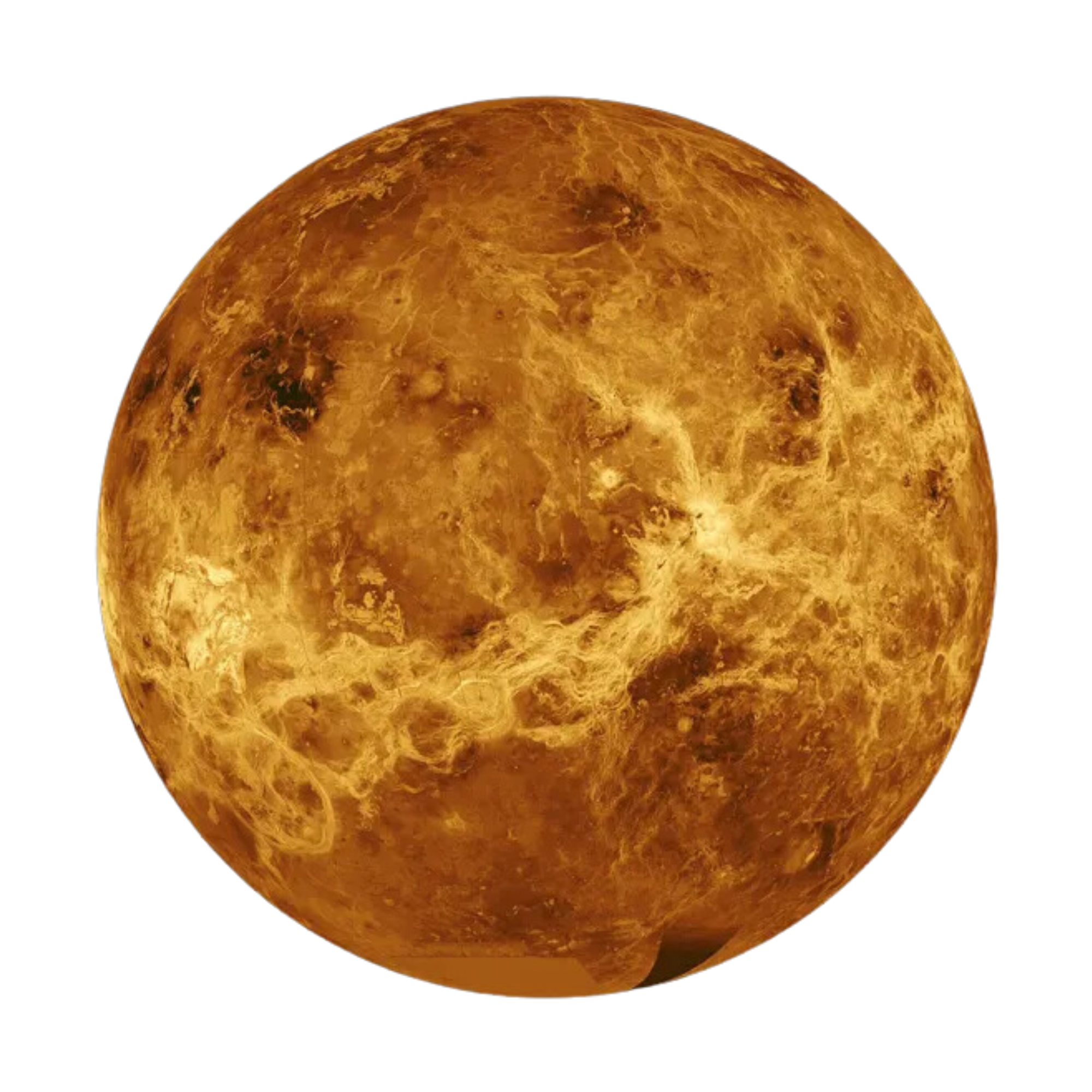
VENUS
has a thick atmosphere, making it the hottest planet in our solar system
Formation
Like all the other planets, Venus was likely formed in the large cloud of gas, dust, and ice of the ancient solar system, which collapsed into a spinning disc. Our Sun was born at its centre, and the planets were created about 4.5 billion years ago from particles sticking together along rings in the disc.
Venus is the second closest planet to the Sun and is often called s "sister planet" or "twin planet." Venus and Earth have very similar sizes, masses, and compositions, but are otherwise quite different from each other. Scientists think that in the early days of the solar system, Venus may have been similar to present-day Earth and may even have had liquid water on its surface.
Orbit and rotation
Venus is the only planet that rotates clockwise; all the other planets rotate counter-clockwise. Venus's rotation is called retrograde rotation.
One day on Venus – the time it takes the planet to complete a full rotation on its axis – is equal to 243 days on Earth. That is actually slower than the time it takes for Venus to complete one orbit around the Sun, which takes 225 Earth days.
On Venus, as on, a year is actually shorter than a day!
Surface
Venus shows evidence of very strong volcanic activity and likely has more volcanoes than our planet. Scientists have never seen an active lava flow on Venus, but they estimate that 80% of the planet's surface is covered by smooth, volcanic plains that are left over from previous lava flows.
Venus is entirely cloaked in thick clouds that hide its surface. In order to study it, scientists must use either spacecraft that land on the planet or radar technology on board satellites or probes.
Temperature and atmosphere
Despite being only the second planet from the Sun, Venus (not ) is the hottest planet in our solar system.
Venus's high temperature is caused by its extremely thick atmosphere, which is over 90 times thicker than Earth's! This outer layer is composed almost entirely of carbon dioxide, a well-known gas responsible for a very strong greenhouse effect. Trapped by Venus's atmosphere, the Sun's energy heats the planet to constant temperatures over 450 degrees Celsius.
The exploration of Venus
The first exploration of Venus was done by the Soviet probe Venera 1. Launched in 1961, the spacecraft was supposed to fly by Venus to take a closer look at the planet. Unfortunately, the probe malfunctioned before it made its closest approach.
Many other spacecraft were launched to study Venus, including several that landed on the planet's surface. The Soviet Venera program and the American Mariner and Pioneer campaigns of the 1960s and 1970s all allowed scientists to better understand the scorching planet, including its atmosphere, magnetic field, and geology. Due to the incredibly harsh conditions on Venus, and the crushing weight of its thick atmosphere, no lander has ever been able to survive there for longer than 127 minutes.
Venus is often used to spacecraft on their way to other destinations. For example, the Galileo spacecraft swung by Venus before heading out to , its central target. During its brief observation of Venus, Galileo gathered data that hinted at the existence of lightning on the planet. More recent observations show that lightning is even more common on Venus than on Earth.

Infographic about Venus, the second planet from the Sun. (Credit: Canadian Space Agency)