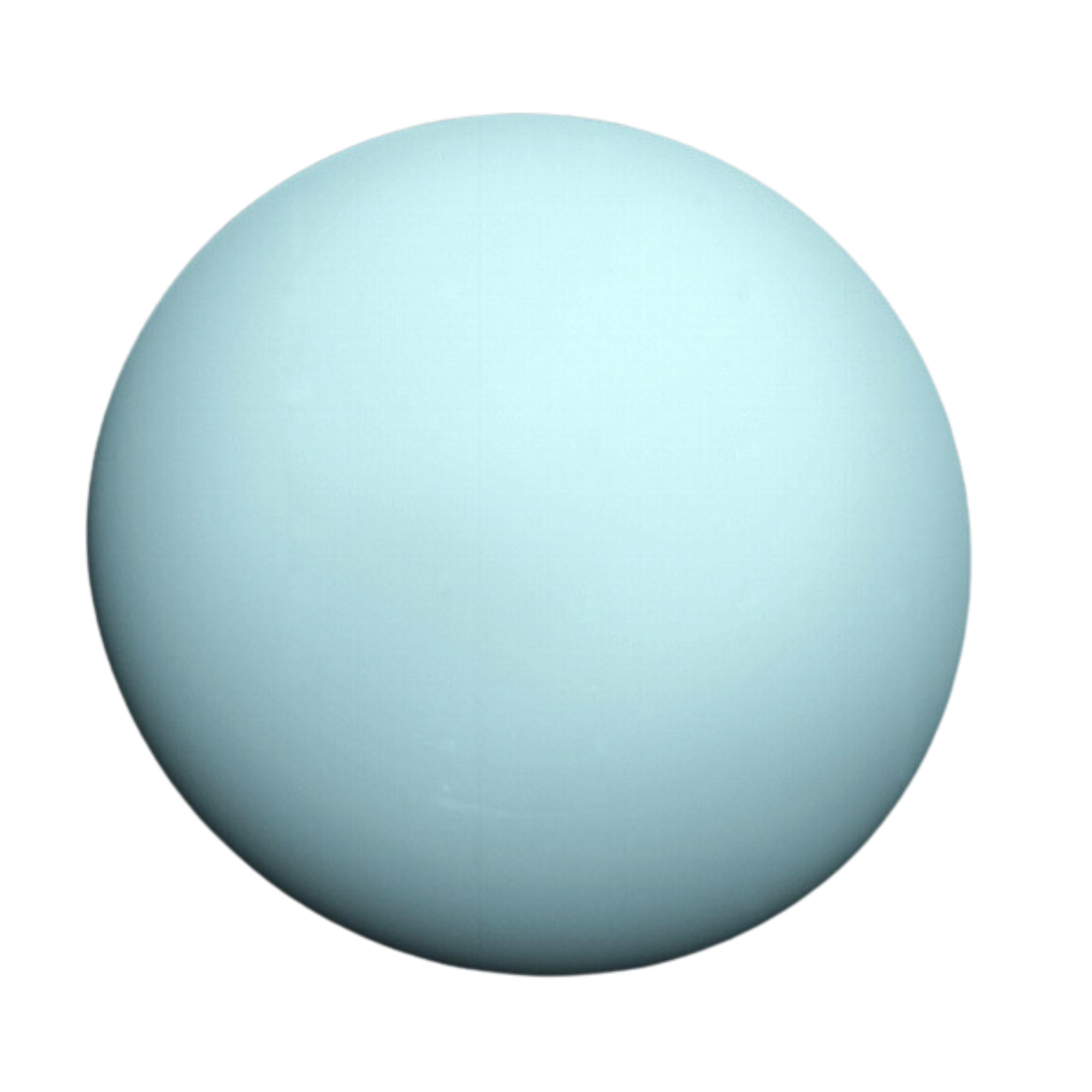
URANUS
a giant planet
with a ring of ice particles
Formation
Uranus is the seventh planet from the Sun and is considered an ice giant because it is largely made up of water, ammonia, and methane in solid form. Like all the other planets, Uranus was likely formed in a massive, ancient cloud of gas, dust, and ice that collapsed into a spinning disc. Our Sun was born at its centre, and the planets were created about 4.5 billion years ago from particles sticking together along rings in the disc. Scientists believe the differences between ice giants and gas giants (like and ) are due to their slightly different formation histories.
Orbit, rotation and tilt
A day on Uranus lasts about 17 hours. Interestingly, different parts of Uranus rotate at different speeds: while the interior of the planet spins in that time, its upper atmosphere completes a full rotation three hours faster, which creates some of the most violent winds in the solar system. Near Uranus's poles, they blow in the same direction as the rotation of the planet. Closer to the equator, the winds blow in the opposite direction!
Uranus takes 84 years to complete one full orbit around the Sun.
Instead of rotating vertically like all of the other planets, Uranus spins around a horizontal axis. Scientists believe that an Earth-sized planet may have collided with Uranus and knocked it on its side.
Uranus's dramatic 98-degree tilt gives rise to the most extreme seasons in the solar system. For nearly 21 years, a quarter of the Uranian year, one pole is bathed in sunlight while the other exists in complete darkness. For the next 21 years, both poles receive similar amounts of sunlight as they gradually switch places and the cycle repeats.
Atmosphere and Surface
Like the other giant planets in our solar system, Uranus does not have a solid surface. Scientists believe that the interior is made up of a solid rocky core covered by a dense liquid layer of water and ammonia. The atmosphere surrounding the interior of the planet is mostly hydrogen and helium. Despite having the second fastest winds in the solar system (after Neptune), Uranus's atmosphere looks quite calm. Very few clouds are observed in its light blue atmosphere.
Composition
Scientists believe Saturn may contain an extremely hot, small solid core made up of iron and nickel, surrounded by several layers of hydrogen and helium in different phases. The intense pressure and heat within Saturn are so great that these gases are compressed into liquids and metals.
Saturn is the only planet with a density lower than water. That means that if you were to find a large enough bathtub to put Saturn in, the massive planet would float!
Rings
Although is best known for its elaborate ring system, all of the giant planets in our solar system have rings of their own. Uranus has 13 distinct rings made up of very dark particles, quite different from Saturn's rings, which are mostly water ice. Scientists believe that Uranus's rings formed after the planet took shape, from the leftovers of destroyed moons. The rings are tilted about 90 degrees and match Uranus's rotation.
The exploration of Uranus
Launched in 1977 to explore the outer solar system, NASA's Voyager 2 was the only spacecraft to fly relatively close to Uranus. It surveyed the planet from a distance of about 80,000 km in 1986 before moving on to the neighbouring ice giant, Neptune. During its short observation of Uranus, the probe studied the planet's atmosphere, magnetic field, ring system and many of its moons. The spacecraft's observations even helped scientists discover 10 of the planet's natural satellites.

This infographic features an image of Uranus along with a series of facts that highlight
some of the differences between Uranus and Earth. (Credit: CSA)