Intro
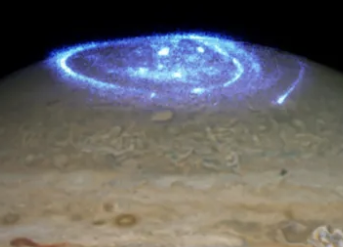
On Earth, the aurora borealis, or the northern lights, is a spectacular natural phenomenon. However, you might not be aware that Jupiter also experiences auroras, and they are even more spectacular than those on Earth, and they persist continuously! On Earth, auroras are produced when charged particles from the solar wind interact with Earth's magnetic field. These particles are guided to Earth's polar regions, causing gases in the atmosphere to emit various stunning colors. However, Jupiter's situation is slightly different. Jupiter has a powerful magnetic field, much stronger than Earth's, and its auroras are generated by the interaction between charged particles from the solar wind and Jupiter's magnetic field. Additionally, particles from its numerous moons also collide with Jupiter, contributing to the continuous production of auroras. Due to Jupiter's stronger magnetic field, its auroras are much larger and more spectacular than those on Earth. Furthermore, unlike Earth's auroras, Jupiter's auroras appear to be continuous and do not stop after a certain period. This makes Jupiter a truly awe-inspiring astronomical spectacle, capturing the attention of astronomers and space explorers alike. Therefore, if you have the opportunity, observing Jupiter's auroras is sure to be an unforgettable experience!