Intro
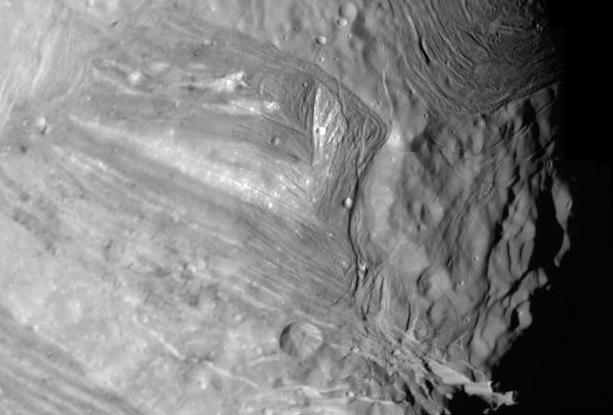
Miranda, a moon of Uranus, boasts a tumultuous history. Discovered by Gerard Kuiper in 1948, it's one of Uranus' larger inner moons, with a diameter of around 300 miles. However, it wasn't until Voyager 2's 1986 close encounter that Miranda unveiled its astonishing complexity. Miranda's surface features valleys, ridges, and intriguing geological formations, suggesting it underwent five distinct phases of fracturing, resulting in its remarkable topography. This makes Miranda an ideal destination for adventurous terrain exploration. One of Miranda's distinctive features is the "coronae," massive groove-like structures believed to result from icy punctures or extrusions, potentially altering its internal density distribution and causing self-reorganization. Miranda's geological history suggests tidal heating during periods of higher eccentricity and its escape from a 3:1 orbital resonance with Umbriel, underscoring its unique past. Early formation theories have been discarded, and current research aims to unravel its strange landscape. Miranda's name, from William Shakespeare's "The Tempest," adds literary charm. Visitors can embark on thrilling terrain exploration activities, turning their journey into an exciting adventure.